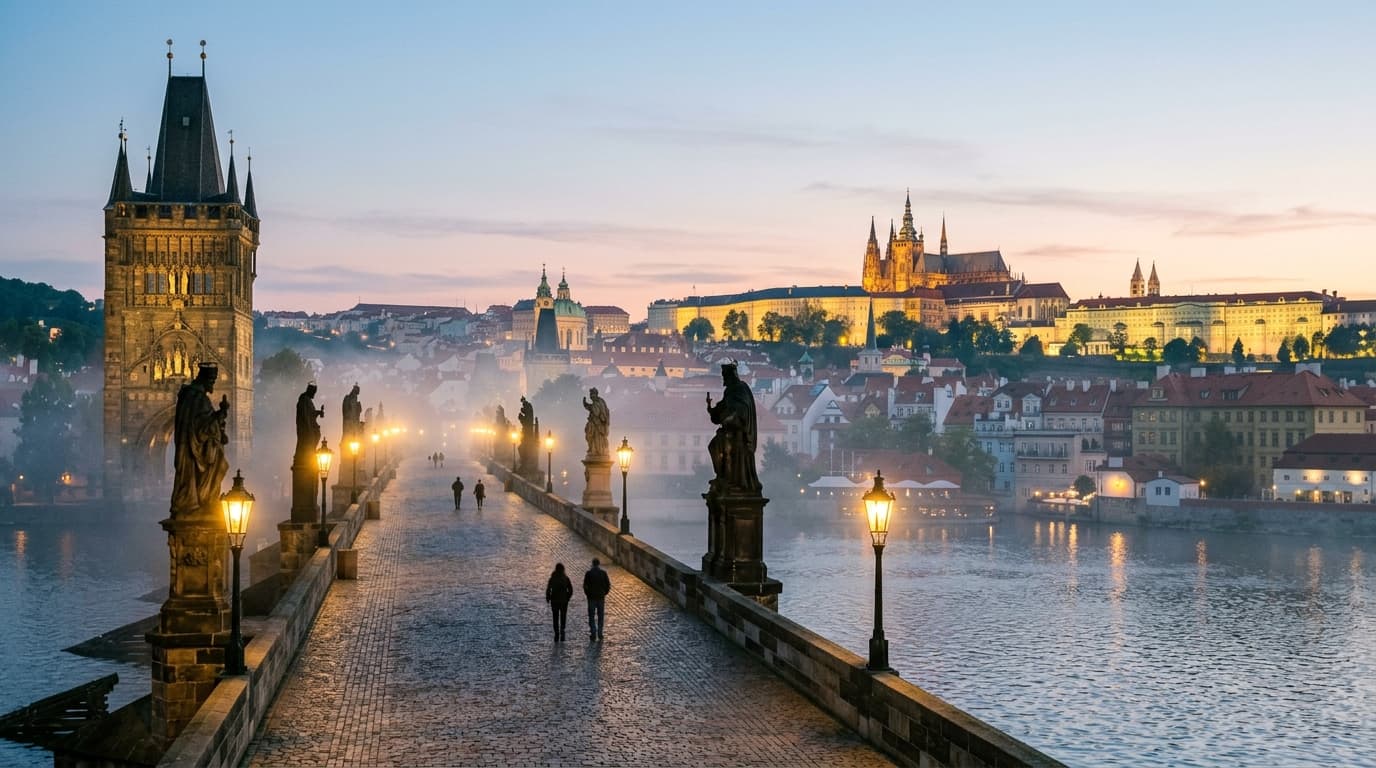
Spanning the tranquil waters of the Vltava River, Charles Bridge (Karlův most)—the 516-meter medieval Gothic stone arch bridge commissioned by Holy Roman Emperor Charles IV in 1357—has inaugurated a comprehensive heritage conservation program and expanded evening visitor access across its historic guard towers and Prague Castle approach.
Medieval Engineering and the 30 Baroque Statues
Engineered by master builder Peter Parler from Bohemian sandstone, Charles Bridge served for over four centuries as the only permanent river crossing connecting Prague's Old Town (Staré Město) with the Lesser Town (Malá Strana) and Prague Castle. The bridge's parapets are famously decorated with a gallery of 30 monumental baroque statues depicting saints and patron figures, sculpted by celebrated artists including Matthias Braun and Ferdinand Brokoff between 1683 and 1714.
Under the continuous bridge conservation initiative directed by the National Heritage Institute (Národní památkový ústav), delicate sandstone originals have been transferred to the subterranean lapidarium at Gorlice inside Vyšehrad fortress to shield them from atmospheric weathering, replaced on the bridge by masterfully hand-chiseled exact replicas crafted by certified Czech master stone carvers.
"Charles Bridge is not merely a transport artery; it is an open-air sacred sculpture gallery and the beating heart of Prague's architectural identity," noted Head Conservator Tomáš Řehoř. "By opening our restoration workshops to public viewing, we celebrate seven centuries of traditional European stonemasonry."
Gothic Bridge Towers and Evening Skyline Panoramas
As part of the new cultural offerings, the Old Town Bridge Tower (Staroměstská mostecká věž)—widely regarded as one of the finest civilian Gothic monuments in Europe—has extended its opening hours until 10:00 PM. Visitors climbing its 138 winding spiral steps reach an open viewing gallery offering unmatched 360-degree vistas of the bridge's illuminated cobblestones, the illuminated silhouette of St. Vitus Cathedral, and the sprawling Prague Castle complex on the western hill.
Inside the tower, a newly curated exhibition showcases medieval astrological calculations used to determine the bridge's exact foundation laying time (1357, 9th of July, at 5:31 AM—forming a palindromic number sequence 135797531 believed to bestow eternal permanence).
Practical Touring Strategies & Visitor Advice
To experience Charles Bridge and Prague Castle without the midday tourist congestion:
- Dawn Walking Experience: Visit the bridge between 6:00 AM and 7:30 AM to witness sunrise breaking over the Gothic spires of Old Town with misty river reflections and almost no crowds.
- Combined Castle Circuit: Purchase the Prague Castle "Circuit A" or "Circuit B" ticket online to explore St. Vitus Cathedral, the Old Royal Palace, St. George's Basilica, and Golden Lane.
- Tower Pass Discounts: Purchase a multi-tower Prague Heritage Pass for combined entry to the Old Town Bridge Tower, the Lesser Town Bridge Towers, and the Old Town Hall Astronomical Clock Tower.
- Respectful Navigation: The entire span of Charles Bridge is pedestrianized; watch out for certified street artists, musicians, and licensed souvenir vendors operating in designated bays.
Crossing Charles Bridge under the golden glow of Prague's gas lanterns remains an unforgettable journey into the fairy-tale majesty of Central European heritage.
Architectural Significance & Historical Lineage
Understanding the broader context of this landmark requires examining its profound historical and civic lineage. From initial structural masterplans to contemporary conservation methodologies, the site reflects generations of visionary engineering ambition and material mastery. International architectural critics frequently cite its distinctive spatial organization as a pivotal benchmark in global heritage design, illustrating how historic integrity can successfully adapt to 21st-century environmental, technological, and operational demands.
Specialized conservation teams continuously monitor structural tolerances using non-invasive laser telemetry, micro-environmental sensors, and advanced material analysis. These ongoing technical investments ensure that the landmark remains completely resilient against climate fluctuations, heavy visitor footfall, and urban atmospheric conditions while preserving its authentic historic fabric.
Sustainability, Transit Connectivity & Neighborhood Context
In accordance with global sustainable tourism charters, local municipal authorities have integrated the attraction into wider pedestrianized zones and low-emission transit networks. Travelers are encouraged to utilize high-frequency public transportation links, electric shared mobility corridors, and scenic walking boulevards that connect the monument directly to nearby cultural quarters, independent artisan boutiques, and regional culinary establishments.
The surrounding district offers travelers an array of authentic cultural encounters within easy walking distance. Exploring the adjacent historic streets reveals hidden courtyards, neighborhood bistros, and specialized heritage bookshops that provide deeper insight into the local community's enduring relationship with its world-famous landmark.
WAT Editorial Bureau Takeaway & Travel Outlook
As international travel demand continues to set new benchmarks, this milestone development reinforces the destination's position at the vanguard of cultural stewardship and immersive visitor experience. Whether embarking on a first-time architectural pilgrimage or returning for an in-depth rediscovery, travelers who plan ahead with verified time-slot reservations and respectful cultural awareness will find an encounter of unmatched majesty and inspiration.