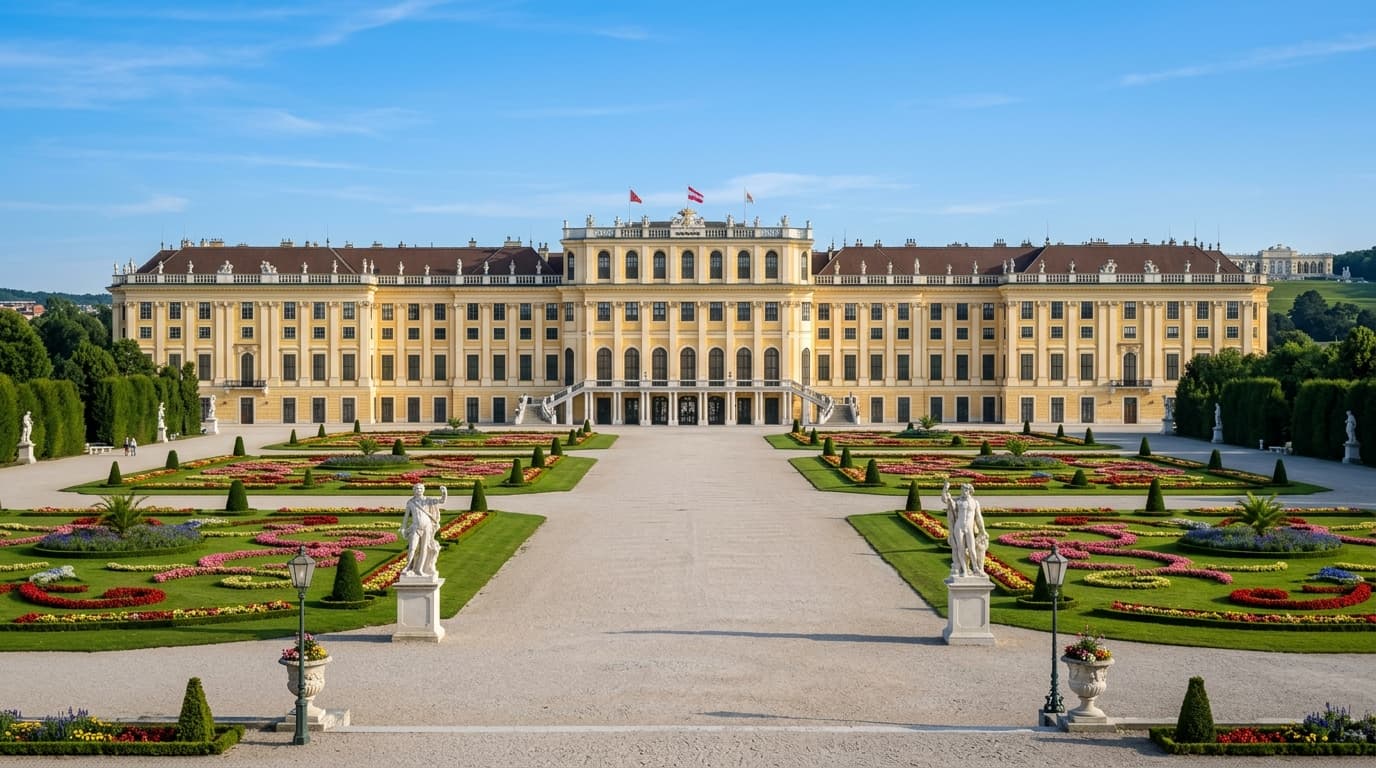
In the imperial Austrian capital of Vienna, Schönbrunn Palace (Schloss Schönbrunn)—the 1,441-room baroque masterpiece and UNESCO World Heritage residence of the Habsburg emperors—has unveiled the most comprehensive interior restoration of its Imperial Grand Apartments in over fifty years. The project returns the private living quarters of Empress Maria Theresa and Emperor Franz Joseph I to their authentic 18th- and 19th-century brilliance.
Rococo Opulence and Masterful Textile Conservation
The multi-year restoration centered on the palace's most celebrated ceremonial halls, including the Great Gallery (Große Galerie), the Millions Room (Millionenzimmer), and the Hall of Ceremonies. Master Austrian conservators meticulously cleaned over 1,200 square meters of 23-karat gold-leaf stucco ornaments, crystal chandeliers, and ceiling frescoes painted by Italian master Gregorio Guglielmi.
In the Millions Room, world-renowned for its rare Indo-Persian miniature paintings set into precious rosewood paneling, conservators used advanced climate-stabilizing glass vitrines to shield the delicate 16th-century gouache pigments from ambient humidity shifts. The Emperor's private bedchamber and the Walnut Room (Walnusszimmer) have also been fitted with custom-woven silk damask wall coverings recreated on historic Viennese jacquard looms.
"Schönbrunn is a living chronicle of European diplomacy, courtly romance, and imperial architecture," explained Palace Managing Director Franz Sattlecker. "This restoration allows guests to experience the exact visual and tactile atmosphere that Wolfgang Amadeus Mozart encountered when performing for the Empress as a six-year-old prodigy in 1762."
Baroque Garden Illumination and the Gloriette Promenade
Beyond the palace walls, the vast 160-hectare imperial gardens have debuted the "Schönbrunn Twilight Promenade." As the sun sets behind the Neptune Fountain, discreet subterranean lighting illuminates the sculpted yew hedges, classical marble deities, and the majestic hilltop Gloriette triumphal arch.
Visitors can ascend to the Gloriette viewing terrace to enjoy breathtaking panoramic views spanning the palace roofscape and the entire Vienna city skyline. The historic Orangery—one of the largest baroque conservatories in Europe—continues to host evening classical concerts featuring the Schönbrunn Palace Orchestra performing masterpieces by Mozart and Johann Strauss.
Visitor Logistics & Imperial Tour Advice
To ensure a flawless visit to Austria's most visited cultural attraction:
- Grand Tour vs. Imperial Tour: The "Grand Tour" (40 rooms) includes both the Franz Joseph state rooms and the opulent Maria Theresa 18th-century staterooms; it is highly recommended over the shorter "Imperial Tour" (22 rooms).
- Timed Ticket Necessity: Stateroom access is strictly capacity-controlled; book tickets online at least 48 hours in advance to secure preferred entry times.
- Complimentary Audioguides: High-definition audio guides (and smartphone web app tours) are included with all tickets in 16 languages.
- Gardens & Maze Access: Entry to the main palace gardens is free; however, specialty areas such as the Maze, the Privy Garden (Kronprinzengarten), and the Palm House require individual tickets or an all-inclusive Classic Pass.
Schönbrunn Palace stands as an incomparable jewel of European monarchical heritage, celebrating the grandeur and cultural legacy of Vienna's imperial golden age.
Architectural Significance & Historical Lineage
Understanding the broader context of this landmark requires examining its profound historical and civic lineage. From initial structural masterplans to contemporary conservation methodologies, the site reflects generations of visionary engineering ambition and material mastery. International architectural critics frequently cite its distinctive spatial organization as a pivotal benchmark in global heritage design, illustrating how historic integrity can successfully adapt to 21st-century environmental, technological, and operational demands.
Specialized conservation teams continuously monitor structural tolerances using non-invasive laser telemetry, micro-environmental sensors, and advanced material analysis. These ongoing technical investments ensure that the landmark remains completely resilient against climate fluctuations, heavy visitor footfall, and urban atmospheric conditions while preserving its authentic historic fabric.
Sustainability, Transit Connectivity & Neighborhood Context
In accordance with global sustainable tourism charters, local municipal authorities have integrated the attraction into wider pedestrianized zones and low-emission transit networks. Travelers are encouraged to utilize high-frequency public transportation links, electric shared mobility corridors, and scenic walking boulevards that connect the monument directly to nearby cultural quarters, independent artisan boutiques, and regional culinary establishments.
The surrounding district offers travelers an array of authentic cultural encounters within easy walking distance. Exploring the adjacent historic streets reveals hidden courtyards, neighborhood bistros, and specialized heritage bookshops that provide deeper insight into the local community's enduring relationship with its world-famous landmark.
WAT Editorial Bureau Takeaway & Travel Outlook
As international travel demand continues to set new benchmarks, this milestone development reinforces the destination's position at the vanguard of cultural stewardship and immersive visitor experience. Whether embarking on a first-time architectural pilgrimage or returning for an in-depth rediscovery, travelers who plan ahead with verified time-slot reservations and respectful cultural awareness will find an encounter of unmatched majesty and inspiration.