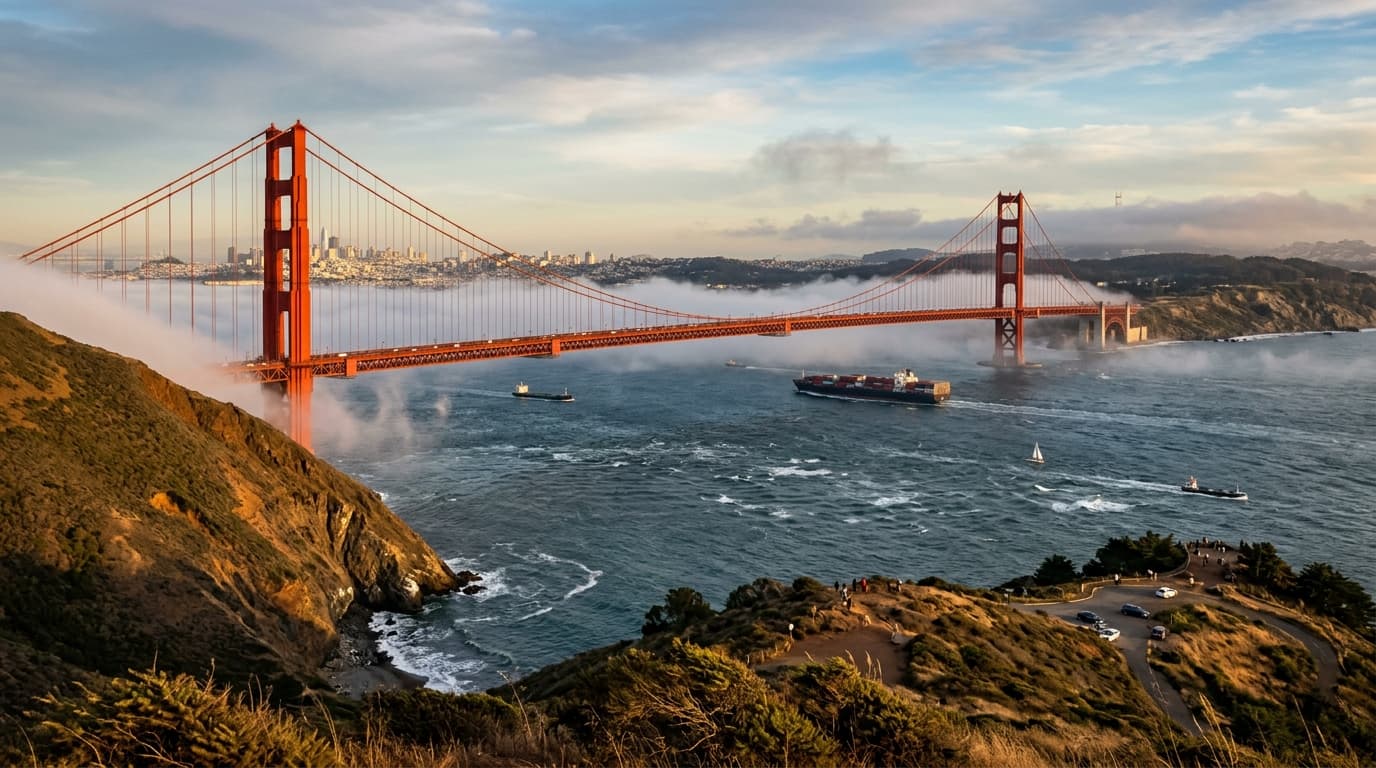
Spanning the treacherous mile-wide strait connecting San Francisco Bay to the Pacific Ocean, the Golden Gate Bridge—the internationally celebrated 1.7-mile suspension masterpiece painted in signature International Orange—has completed an extensive enhancement of its southern Welcome Plaza, pedestrian accessibility corridors, and panoramic coastal trail connections.
Engineering Brilliance and Seismic Modernization
Completed in 1937 under chief engineer Joseph Strauss and design architect Irving Morrow, the Golden Gate Bridge's Art Deco chevron towers and sweeping main suspension cables were once deemed impossible to construct due to fierce ocean tides, dense fog banks, and gale-force Pacific winds. Today, the Golden Gate Bridge, Highway and Transportation District is finalizing a multi-million-dollar seismic retrofit, installing viscous dampers and steel strengthening plates that enable the bridge to withstand major earthquakes.
At the southern bridgehead within the Presidio national park site, the newly revitalized Golden Gate Bridge Welcome Center features open-air educational exhibits showcasing full-scale cross-sections of the 36.5-inch-diameter main cable (comprising 27,572 individual galvanized steel wires) and interactive wind-tunnel testing models.
"The Golden Gate Bridge is more than a vital transportation conduit; it is an enduring symbol of American resilience and design elegance," remarked Presidio Trust Historian Elena Torres. "Our updated trail network allows guests to experience the bridge from sea level up to its highest coastal bluffs in complete safety."
Scenic Coastal Trail Connections and Marin Viewpoints
The upgraded California Coastal Trail now provides seamless pedestrian and cycling connections from the Welcome Plaza through the Presidio bluffs to historic Fort Point National Historic Site directly beneath the southern arch. Visitors can gaze straight up into the soaring steel truss underbelly of the bridge while listening to the resonant sound of fog horns echoing across the strait.
Across the bridge to the north, newly stabilized hiking paths lead up to the Marin Headlands, Battery Spencer, and Hawk Hill, providing world-class vantage points for photographers capturing the bridge framed against the San Francisco skyline at sunrise and sunset.
Visitor Logistics & Transportation Advice
To avoid severe parking congestion and maximize your Golden Gate Bridge visit:
- Pedestrian vs. Cyclist Hours: The East Sidewalk is dedicated to pedestrians during daylight hours (electric scooters and skateboards are strictly prohibited); cyclists utilize the West Sidewalk or designated cycling lanes.
- Public Transit over Driving: Parking at the Welcome Plaza is extremely limited and subject to strict 15-minute limits on weekends; take Muni bus lines (28, 28R) or the free Presidio GO Shuttle directly to the bridgehead.
- Weather Preparation: The bridge strait is notorious for sudden temperature drops and dense summer "Karl the Fog" conditions; dress in warm windproof layers even on warm sunny days in the city.
- Toll Payment: Motorists driving southbound into San Francisco must note that the bridge is 100% all-electronic tolling (no cash booths); tolls are billed automatically via FasTrak or Pay-By-Plate.
Walking across the Golden Gate Bridge remains one of the world's most exhilarating urban adventures, uniting natural marine majesty with towering human engineering.
Architectural Significance & Historical Lineage
Understanding the broader context of this landmark requires examining its profound historical and civic lineage. From initial structural masterplans to contemporary conservation methodologies, the site reflects generations of visionary engineering ambition and material mastery. International architectural critics frequently cite its distinctive spatial organization as a pivotal benchmark in global heritage design, illustrating how historic integrity can successfully adapt to 21st-century environmental, technological, and operational demands.
Specialized conservation teams continuously monitor structural tolerances using non-invasive laser telemetry, micro-environmental sensors, and advanced material analysis. These ongoing technical investments ensure that the landmark remains completely resilient against climate fluctuations, heavy visitor footfall, and urban atmospheric conditions while preserving its authentic historic fabric.
Sustainability, Transit Connectivity & Neighborhood Context
In accordance with global sustainable tourism charters, local municipal authorities have integrated the attraction into wider pedestrianized zones and low-emission transit networks. Travelers are encouraged to utilize high-frequency public transportation links, electric shared mobility corridors, and scenic walking boulevards that connect the monument directly to nearby cultural quarters, independent artisan boutiques, and regional culinary establishments.
The surrounding district offers travelers an array of authentic cultural encounters within easy walking distance. Exploring the adjacent historic streets reveals hidden courtyards, neighborhood bistros, and specialized heritage bookshops that provide deeper insight into the local community's enduring relationship with its world-famous landmark.
WAT Editorial Bureau Takeaway & Travel Outlook
As international travel demand continues to set new benchmarks, this milestone development reinforces the destination's position at the vanguard of cultural stewardship and immersive visitor experience. Whether embarking on a first-time architectural pilgrimage or returning for an in-depth rediscovery, travelers who plan ahead with verified time-slot reservations and respectful cultural awareness will find an encounter of unmatched majesty and inspiration.